
Bond Prices Explained Simply
FIXED INCOME
“Interest rates are gravity for asset prices.” — Warren Buffett
Bond Prices Explained Simply
In the hierarchy of investing, bonds are frequently characterized as the "boring" counterpart to equities. They are sought for their stability, their predictable income, and their role as a portfolio stabilizer. However, many investors are caught off guard when they open their brokerage statements and see the market value of their bond holdings in the red.
This confusion often stems from a fundamental misunderstanding of how fixed income is priced. To build a resilient portfolio, an investor must look past the surface-level "safety" of bonds and understand the mechanics that drive their value.
As explored in our comprehensive guide, [Fixed Income: The Asset Class Most Investors Misunderstand], the complexity of bonds does not lie in their purpose, but in their pricing.
The Bond as a Contractual Loan
To understand bond prices, one must first view a bond not as a "stock that pays interest," but as a legal contract. When you buy a bond, you are lending money to an entity—a government or a corporation—for a specific period.
The terms of this contract are generally fixed:
Par Value: The amount you will receive back when the bond matures (usually $1,000).
Coupon Rate: The fixed annual interest payment.
Maturity Date: The date the loan ends and the principal is returned.
The "Fixed" in Fixed Income refers to the coupon. If you buy a bond with a 4% coupon, that dollar amount will not change. However, because the world around the bond changes—specifically interest rates and inflation—the market value of that contract must fluctuate to remain competitive.
The Mechanics of the Inverse Relationship
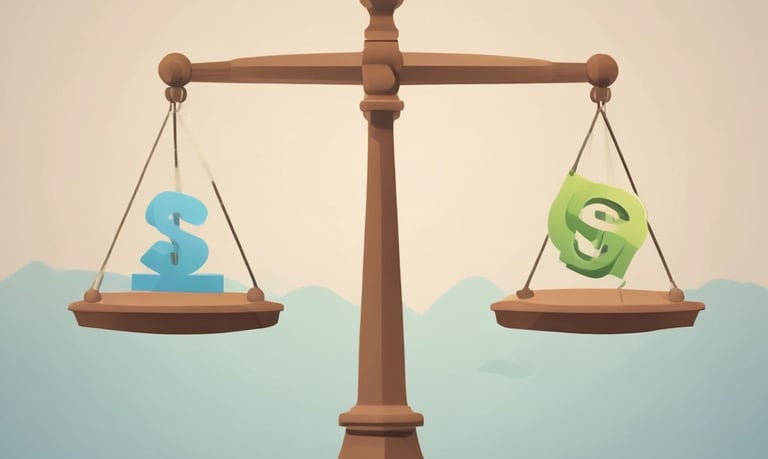
The most important rule in fixed income is that bond prices and interest rates move in opposite directions. When interest rates rise, bond prices fall. When interest rates fall, bond prices rise.
This is not a market quirk; it is a mathematical necessity based on opportunity cost.
Consider a simple scenario. You purchase a new 10-year bond for $1,000 that pays a 3% interest rate ($30 per year). One year later, the central bank raises interest rates. New 10-year bonds are now being issued with a 5% interest rate ($50 per year).
If you decide to sell your 3% bond, no rational investor will pay you $1,000 for it. Why would they lend $1,000 to receive $30 when they could lend that same $1,000 elsewhere and receive $50?
To make your 3% bond attractive to a buyer, you must lower the price. You must sell it at a "discount." The price of your bond will drop until its $30 payment, combined with the eventual return of the $1,000 principal, equals a total return (yield) of roughly 5%.
Conversely, if interest rates had dropped to 1%, your 3% bond would be highly desirable. Investors would be willing to pay a "premium"—more than $1,000—to secure that higher income stream.
Understanding Yields: Coupon vs. YTM
A common error among retail investors is focusing solely on the "Coupon Rate." While the coupon tells you what the bond pays based on its original value, it does not tell you what the bond is worth today.
Current Yield: This is the annual interest payment divided by the bond's current market price. If you bought a bond for $900 that pays $40 in interest, your current yield is 4.4%.
Yield to Maturity (YTM): This is the more critical metric. YTM calculates the total return you can expect if you hold the bond until it matures. it accounts for the interest payments plus any capital gain (if you bought at a discount) or capital loss (if you bought at a premium).
[Internal link: Asset Allocation Matters More Than Asset Selection]
For the long-term investor, YTM is the most "honest" number. it reflects the actual anticipated return of the investment, regardless of the noise in daily price fluctuations.
Duration: The Measure of Sensitivity
Not all bonds react to interest rate changes with the same intensity. The primary determinant of a bond’s price volatility is its "duration."
Duration is a measure, expressed in years, of how long it takes for an investor to be repaid the bond’s price by its total cash flows. In practical terms, it functions as a sensitivity gauge.
As a rule of thumb: for every 1% change in interest rates, a bond’s price will change by approximately 1% for every year of duration.
A bond with a 2-year duration is relatively stable. If rates rise 1%, the price may drop by roughly 2%.
A bond with a 20-year duration is highly sensitive. If rates rise 1%, the price could drop by roughly 20%.
Long-term bonds carry more "interest rate risk" because there is a longer period of time during which rates could rise, making the bond's fixed coupon less valuable. Investors must decide if the typically higher yields offered by long-term bonds justify the increased price volatility.
The Role of Inflation and Credit Risk
While interest rates are the primary driver of bond prices, they do not act in a vacuum. Two other factors play significant roles:
1. Inflation Expectations Inflation is the enemy of the bondholder. Because a bond pays a fixed amount of dollars in the future, if those dollars lose purchasing power, the bond becomes less valuable. If inflation expectations rise, investors will demand higher yields to compensate for the loss of purchasing power, driving bond prices down.
2. Credit Risk A bond price also reflects the market’s confidence in the borrower's ability to pay. If a corporation’s financial health declines, the risk of default increases. To compensate for this risk, the price of the bond will fall, which increases the yield. This is known as "spread widening."
[Internal link: Credit Spreads and Risk: Evaluating Corporate vs. Government Debt]
Behavioral Discipline: Price vs. Value
For the disciplined investor, seeing a "loss" on a bond position requires a shift in perspective.
If you own an individual bond and intend to hold it to maturity, the daily price fluctuations are largely irrelevant to your ultimate outcome. Provided the issuer does not default, you will receive your interest payments and your full principal back. The "loss" shown in your account is an opportunity cost—the cost of being locked into a lower rate—rather than a permanent destruction of capital.
However, for investors in bond funds, the situation is different. Funds do not have a single maturity date; they constantly buy and sell bonds to maintain a specific duration. In a rising rate environment, a bond fund manager will eventually replace older, lower-yielding bonds with newer, higher-yielding ones. Over time, this increases the fund's income, but the initial price drop can be painful for those with a short time horizon.
Summary of Tradeoffs
Investing in bonds involves a constant set of tradeoffs:
Safety vs. Yield: Government bonds offer the highest safety but lower yields; corporate bonds offer higher yields but carry credit risk.
Stability vs. Duration: Short-term bonds offer price stability but lower yields; long-term bonds offer higher potential returns but significant price volatility.
The goal of the rational investor is not to avoid price fluctuations entirely, but to ensure that the duration of their bond holdings aligns with their financial goals.
Grounded Takeaway
Bond prices are not driven by sentiment or hype, but by the cold math of the credit markets. When rates rise, your existing bonds become less valuable to the rest of the world, even if their value to you—as a source of predictable income—remains unchanged.
Discipline in fixed income investing means accepting that "safe" does not mean "static." By understanding duration and the inverse relationship between price and yield, you can move away from reacting to market noise and toward a structural understanding of your portfolio’s performance.
Focus on the contractual certainty of the cash flows rather than the daily fluctuations of the market. In the long run, the math of the bond contract tends to reward the patient holder.